 Willingham Weavery Classes
Towelapalooza 25, first session ~ Jan 16-18, 2025
Towelapalooza 25, second session ~ Jan 20-22, 2025
Weaving Fundamentals ~ Jan 27-31, 2025
Continuing Weaving: TBD ~ Feb 3-7, 2025
from
Janet Dawson & Sue Willingham
at the Willingham Weavery
Mother and daughter Sue Willingham of The Willingham Weavery and Janet Dawson of Weaving with Janet Dawson are an international, east-meets-west, island to island, border hopping, mother/daughter weaving duo extraordinaire! They live on opposites coasts of two different countries but visit one another as often as possible and, due to the wonders of the interwebs (and a couple of webcams and hands free phones), they weave “together” almost as much as if they lived down the road. The two of them live and breathe to weave and are often in consultation with one another on projects, on teaching, and on life in general.
Together Janet and Sue represent over 40 years of weaving and teaching experience. Their shared enthusiasm for their craft will inspire you and their mother/daughter antics will entertain you while their breadth of teaching experience and subtle (or not so subtle) differences in approach and technique provide you with a solid foundation of weaving theory and skills that will enable you to weave confidently on your own for years to come.
Weaving Fundamentals
January 27-31, 2025
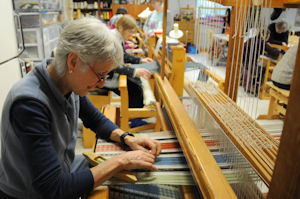
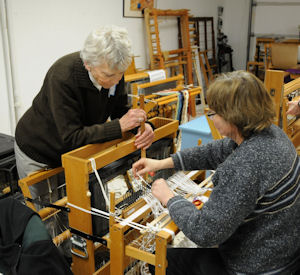
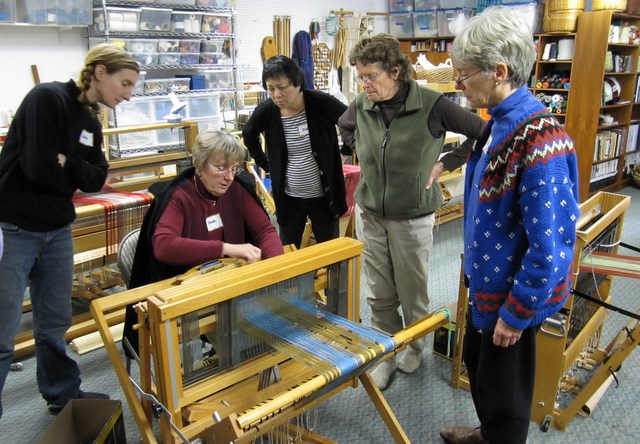
With detailed instructions and step by step guidance, Sue and Janet lead students through the process of planning a project, winding a warp, and dressing a floor loom. Students will have lots of time at the loom each day to learn and practice good weaving techniques and to explore plain weave, twill and basket weave under the guidance of two attentive and experienced instructors.
Each day will also include discussions and demonstrations covering a variety of basic weaving information, skills and techniques, such as record keeping, suggestions for accuracy in dressing the loom and while weaving, the difference between different types of looms, choosing yarns and setts, and much more.
Topics covered:
Loom meet & greet: the parts of a loom and how they work
Other weaving paraphernalia: what it's for and how to use it
Planning a project: choosing threads, set, structure and size
Record keeping
Reading a weaving draft
Dressing a loom
Introduction to simple structures: plain weave, twill and basket weave
How to actually weave: filling bobbins & shuttles, treadling a pattern, throwing the shuttle, maintaining an even beat and tidy selvages
How to avoid and correct mistakes made while weaving
How to stop weaving: hemstitching, hems, knotted fringes and other methods of securing your fabric
How to wet finish cloth
Students should bring their own small, sharp scissors, blunt end tapestry needles, and note taking supplies. All other materials and equipment will be provided (though students who have their own shuttles and bobbins may wish to bring these as well). A materials fee will be charged for yarns and handouts provided.
Towelapalooza 25
two sessions!
January 16-18 or 20-22, 2025
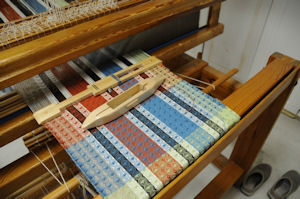
On Vashon they’re dishcloths or dishtowels but in Cape Breton they’re tea towels, which sounds ever so much more civilized. Whatever you call them, they’re hands down The. Most. Popular. thing to weave, and with good reason: it’s a great way to try out new fibres, new colours, new structures without investing a lot of time and money; they’re emminently practical; and they make GREAT gifts. Join us for tea and a round robin of towels in a variety of structures.
This class also provides an opportunity for discussions and demonstrations designed to help students refine their weaving technique, learn advanced weaving skills, increase their understanding of written drafts, and gain comfort and confidence at the loom.
Towelapalooza is designed for students who already have at least a little experience in weaving and reading drafts.
Students should bring their own small, sharp scissors, blunt end tapestry needles, and note taking supplies to class. All other materials and equipment will be provided (though students who have their own shuttles and bobbins may wish to bring these as well). A materials fee will be charged to cover yarns, warping, and handouts provided.
Continuing Weaving: TBD
February 3-7, 2025
Continuing Weaving is designed for students who already have some weaving experience and know how to read a printed draft. The topic for 2025 is yet to be determined.
Students should bring their own small, sharp scissors, blunt end tapestry needles, and note taking supplies to class. All other materials and equipment will be provided (though students who have their own shuttles and bobbins may wish to bring these as well). A materials fee will be charged to cover yarns and handouts provided. The printed materials for this course are extensive; students who bring a blank CD or USB stick can have an electronic copy of all printed materials.
|
|
|
Hours and Registration
Note: For the safety and comfort of all our students, we require that everyone who comes to the studio be fully vaccinated. Masks MAY be required – we will see what the guidance is when the time comes.
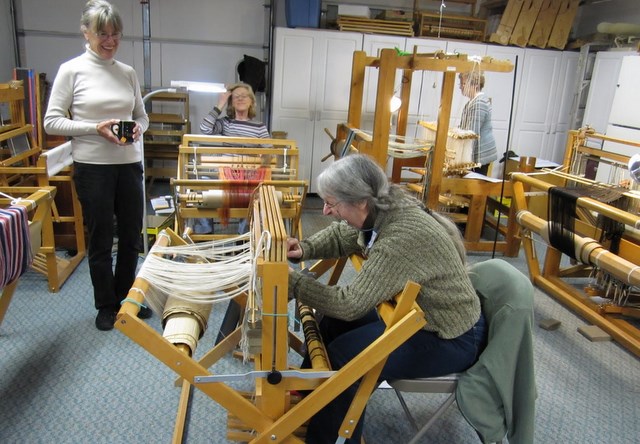
Courses run from 9 am to 4 pm and include formal instruction each morning and afternoon plus several hours of weaving time with two (2!) experienced instructors close at hand, for a total of 6 hours of instruction and supervised weaving each day. In addition, the studio will be open before and after scheduled class times and students are welcome and encouraged to weave on their own as much as they like between classes.
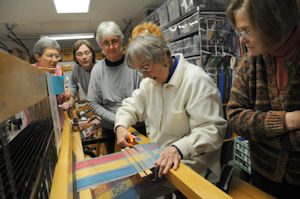
There is a maximum enrollment of 10 students in each course and there will be two (2!) instructors on hand at all times, so students will receive plenty of individual attention and assistance.
Course fees are as follows: One day: $95 plus materials Three day: $310 plus materials Five day: $520 plus materials
There are only ten spots available in each, so register early to
avoid disappointment! A non-refundable deposit made out to the Willingham
Weavery of $150 for three or five day courses and $50 for one day will
hold your place. To register for any course, contact Sue by email at
msuewill[at]gmail[dot]com, by phone at 1-206-463-1747, or by mailing a
cheque to Sue Willingham, PO Box 2395, Vashon, WA 98070-2395. We recommend that
you call before mailing a cheque to make sure that there is still space
available. The balance of registration fees is due by January 10; materials
fees are payable at the start of class.
|
|
|
Praise for Sue and Janet's courses from past students:
"It was a tremendous class from a learning perspective but also very fun. I enjoyed everyone and Sue and Janet really set the tone for a serious, comprehensive and non-threatening class.""It was helpful to have both of you there to guide us and give us your different perspectives. We covered a lot of material!"
"Janet's demo of 'This is what I do when I do like this' was very helpful for me; it gave me permission to speed up, make some noise, and find a new rhythm in my weaving."
"Both of you are born teachers, with a wealth of knowledge and enthusiasm to share. Your attentiveness and sensitivity to each student made being in class a real pleasure."
The Instructors
Janet Dawson

"I've always loved yarn: the colours, the textures, the feel of it in my fingers... As a girl, I used to spend hours sifting through my grandmother's yarn drawer and winding up the tangled skeins into tidy balls, then unwinding them so I could do it all over again. Gramma taught me to knit when I was nine and to crochet a little later but when I moved to Cape Breton Island in 1994 and took my first weaving class, I knew I'd found my place: at the loom.
Though I've always longed to create beautiful things, my strengths run more toward math, computers and mechanics. This makes weaving perfect for me because it combines structure and beauty, balances planning with creativity, and allows exploration within a clearly defined framework. In short, it lets the arty-farty right side of my brain and the techy and mechanical left side of my brain cooperate rather than compete for my attention.
I also love to teach! I come from a long line of teachers so it's in my blood and discovering a new way to explain an old idea so that it finally clicks for someone who's been struggling is a particular delight. That I can combine my two passions for weaving and teaching into an actual job is a constant source of surprise and wonder for me. That I can do it with my mother? Priceless!”
Janet learned to weave at the Cape Breton Centre for Craft and Design in 1994 and has been teaching in person and online since 2000. She’s best known for her Floor Loom Weaving class on Craftsy.com and the classes and weave-alongs she’s been teaching on Zoom since 2020 she also teaches at guilds, schools, and conferences across the US and Canada. Her classes are so popular that they regularly fill before the topic can even be announced!
Janet is a member of the Sydney (Nova Scotia) Weavers' Guild, the Atlantic Spinners and Handweavers, the Guild of Canadian Weavers, Complex Weavers, and the Seattle Weavers Guild, and was the HGA Rep for the Maritime provinces for four years. She has had articles published in the Ontario Spinners & Handweavers magazine, Fibre Focus, and Handwoven Magazine.
Although her focus these days is teaching and selling supplies rather than weaving for sale, her handwoven blankets, scarves, table linens, garments and other items have been sold in shops in the Maritimes for over 20 years and now grace the homes and wardrobes of customers across North America, Europe and as far away as Australia and the country of Georgia. Janet also owns The Bobbin Tree, a store catering to weavers, spinners, knitters and felters.
Sue Willingham
 "Weaving
has become the focus of my life since retirement, a way to be
creative and to be involved with creative people. I especially enjoy
helping people learn to weave and to explore more about weaving. My
students never fail to surprise me with their individual flair -- I
always learn as much as they do!
"Weaving
has become the focus of my life since retirement, a way to be
creative and to be involved with creative people. I especially enjoy
helping people learn to weave and to explore more about weaving. My
students never fail to surprise me with their individual flair -- I
always learn as much as they do!
Sharing a love of weaving with my daughter is, of course, a very special gift. Her enthusiasm is the reason I took my first class. Since then sharing and consulting together has bridged the miles between us. I am really looking forward to teaching these workshops with Janet!"
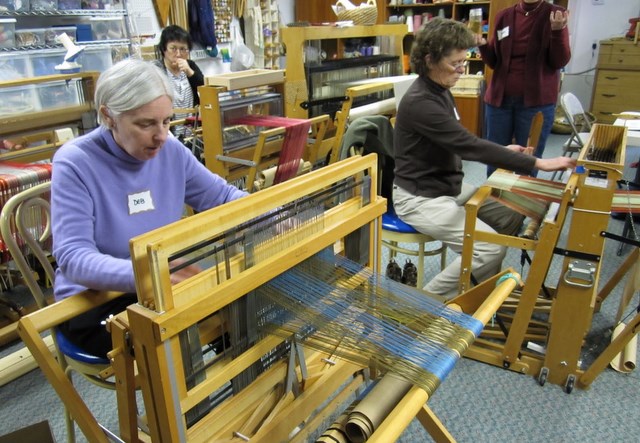
Sue learned to weave in 1996 at the Weaving Works in Seattle – and via phone consultations with Janet! She moved to Vashon Island in 1998 and, after retiring in 2001, had more time to focus on weaving. In 2005 she was asked by friends to teach them to weave. Her living room wasn't big enough so she converted her garage into a studio and later in 2005 opened the Willingham Weavery there. All of her looms were used when she acquired them. Currently there are 10 floor looms and several table looms. Sue's weaving interests are eclectic -- she likes to experiment with new weave structures and various yarns. As looms have been added to her studio, new opportunities arise because of the size and number of shafts.
In 2003 Sue was one of the co-founders FiberNet, a group of Vashon fiber enthusiasts who share, teach, and learn from one another. An outgrowth of FiberNet and of Sue's weaving classes is Vashon Weavers, a group of island weavers that meets regularly and enthusiastically to share and learn.
Sue has been a member of the Seattle Weavers' Guild since 2002 and has served as its president as well as in other positions. For several years (other than 2020 and 2021 due to the pandemic) she has participated in the Vashon Island Holiday Studio Tour the first two weekends in December; other island weavers also show their work at her studio during these tours.
The Willingham Weavery
Sue's studio, The Willingham Weavery, is located on beautiful Vashon Island in the Puget Sound between Seattle and the Olympic peninsula. There are several places for visitors to the island to stay and to eat; anyone coming from away to take the workshops may contact us and we'll provide you with suggestions.
Sue's studio contains looms made by several different manufacturers so students will have an opportunity to meet and test drive jack, countermarche and rigid heddle looms made by Ashford, Glimakra, Harrisville, LeClerc, Macomber, and Schacht – an invaluable experience for anyone considering purchasing a loom for the first time. The Weavery also has a nearly complete set of Handwoven Magazine and many other weaving texts that students may make use of during the week.